
Hey, that's cool. I'm speaking up and there's more than 3 people in the room! Nope, I didn't go on meds or join a Toastmasters Club or take a public speaking course.
I worked on getting a healthy nervous system.
Can't bounce back or go with the flow?
When you have trouble bouncing back from setbacks or 'out of the blue' happenings, the autonomic nervous system is the culprit.
The first thing is to get your nervous system self regulating again.
When your nervous system is regulated, it looks like this . . .
Imagine . . . you worked all day, came home, and flopped on the couch. You feel beat. Your body "lets go".
Your couch gently sinks with the weight of your body - you feel supported in a way your office chair can never do.
Your nervous system adapts to being at home. It begins to release the pent up stress from the day.
Within a few minutes your energy starts to return. You begin to feel energized. A pleasant evening forms in your mind . . . you won't be vegging out in front of the tube tonight!
Have a hard time with emotional swings?
A healthy nervous system bounces back. Under conditions of life challenges and stressors an influx of hormonal energy is triggered to enable us to take action.
And when we're ready to relax the nervous system subsequently discharges that energy.
A new way of looking at self regulation
All organisms from the lowly amoeba to large mammals regulate or process energy to exist. Human beings are no different.
"Regulation" in human beings is a fancy way of describing the way the nervous system handles stress, emotions and more generally, the way it manages energy.
A healthy nervous system manages energy well. It regulates or manages the amount of incoming stimulation with a corresponding amount of energy release.
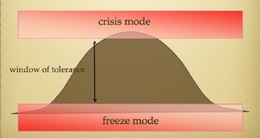
A regulated nervous system can shift easily from high arousal to low arousal, and from neutral, into states of joy and contentment.
Here's how an unhealthy, unregulated nervous system operates:
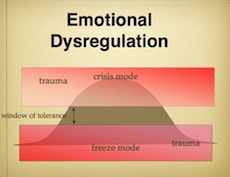
A nervous system that is not regulated cannot discharge the energy in a timely manner.
It has a hard time letting go.
So in the example above, instead of unwinding for a few minutes on the couch and getting your second wind, you remain tired. The stress of the day hangs there all night long and you have nothing left to live your life.
Next day, you get up and start the same cycle all over again. Your life has become very small. You're living in the minimus.
A dysregulated nervous system will non-consciously and physically hold onto the work stress in the muscle and fascia tissue throughout the body.
The hormones triggered by the stress response make individuals with dysregulated nervous systems feel wired yet exhausted at the same time. They may even carry this tension into their sleep.
It means you'll have a hard time in managing your emotions. There's no buffer zone for you to consider how you'd like to respond - and you're more likely to impulsively react.
...which could land you in big doo-doo!
Cause that reaction could be something that just happens inside you (like being crushed and not letting anyone see it) or you could suddenly blurt out an "unkind" word when you didn't really want to
In the graph above that illustrates emotional dysregulation, you'll see that there's not much room for a buffer zone.
Your "window of tolerance" for managing emotions is too small and you're easily pulled in freeze or crisis mode. (The Window of Tolerance is also known as the Working Window or as I refer to it as the Zone of Comfort.)
Anxiety & Depression
The culmination of decades of research on the brain strongly suggests that our nervous system capacity for regulation underlies the quality and stability of our emotions including our ability to manage stress. And furthermore, "the feelings we label "positive" actually reflect body states in which "the regulation of life processes becomes efficient, or even optimal, free-flowing and easy."2
If you suffer from anxiety symptoms or depression then your nervous system is dysregulated by definition. It is the dysregulation of your nervous system that is causing your symptoms.
You may be wondering the million $ question. How do you reset the nervous system so it once again regulates in a healthy way? And yes, it is possible.
Here's how to regulate your nervous system:
It's important to understand that this difficulty in not being able to let go can show up in our thoughts. We may ruminate over problems or become obsessive about an issue that on another day, means little to us.
You see, it's not the problem that's driving the 'wound up' feeling, it's the 'wound up' nervous system that's driving the problem!
Joseph Ledoux, a much respected researcher noted this connection between our thinking brain and the place in the brain where we process emotions and record activation:
"…it is well known that the connections from the cortical areas to the amygdala are far weaker than the connections from the amygdala to the cortex." (3)
Tame your lizard brain!
What Ledoux's words above strongly suggests is that we are far more influenced by our emotional/reptilian parts of our brain than the converse. And this is our biggest clue to understanding how to re-set our nervous system.
That is, while our thoughts can certainly be triggering (i.e. I can get myself riled up by thinking of a bad event), it is more likely that the state of our nervous system (i.e. our level of activation) is having the stronger influence on our thoughts.
I see this dynamic all the time using body psychotherapy with clients. Once I help guide the nervous system into balance (e.g. the noise in the mind is quiet), problems that seemed overwhelming and pressing are felt to be less so.
In many cases we haven't even talked about the problems that have been bothering them.
A typical comment might go something like this:
"You know...this is amazing. I know when I came in my problems seemed way too much, but right now they've sort of faded into the background. I know they're still problems I have to deal with, but right now they don't seem quite so serious or unmanageable. If I felt like this all the time, I'd get them resolved a lot faster."
And over time, this is exactly what happens. The nervous system starts to regulate itself, stress and emotions naturally become easier to manage!
To learn how to improve how your nervous system regulates watch my video on managing emotional overload.
related topics
Resiliency and Bouncing Back
Dysregulation and the Cause of Depression
Stress and Procedural Memory
external links
Self-Regulation Therapy by Dr. LaCombe
notes
1It is very likely that the capacity of a nervous system to be regulated is on a continuum from hightly dysregulated to highly regulated. That is, there's probably no exact point that can clearly distinguish between a dysregulated from a regulated nervous system.
These terms are used on this site for purely descriptive purposes. That is, it is more important to understand that once a nervous system is regulated the individual can process energy in a timely manner.
So for example, I can run an errand, have trouble finding parking, have my car break down in traffic, arrive home to host a dinner party, have a good time that evening and sleep well through the night when my nervous system is regulated.
I can run an errand, get a flat tire and be too stressed to do much else if I have a dysregulated nervous system.
Keep in mind that each individual's nervous system has a different capacity. A nervous system with a large capacity could very likely do much more even in a dysregulated state than another individual with a small nervous system in a regulated state. Also be aware that the size of a nervous system is not necessarily dependent on the physical size although admittedly it no doubt plays an important role.
The capacity of our nervous system is believed to be a function of genetics and our history of trauma and our developmental gaps.
2McCraty, Rollin, Childre, Don.(2010) "Coherence: Bridging Personal, Social, and Global Health." Alternative Therapies, Jul/Aug. Vol. 16, No.4.
3Ledoux, J. "Where the wild things are." The Emotional Brain. (1996) New York: Simon & Schuster, Inc. pg. 225-266.
References
Ledoux, Joseph (1996). The Emotional Brain: The Mysterious Underpinnings of Emotional Life. New York: Touchstone Books.
Levine, Peter, A. (1997). Waking the Tiger: Healing Trauma. Berkeley, California: North Atlantic Books.
Scaer, Robert C.,, "Precarious Present" in Psychotherapy Networker, Nov/Dec 2006.
Scaer, Robert, C., (2005). The Trauma Spectrum, New York: W. W. Norton & Company.
Readers Comments

Sebastian
Anxious most of the time but without anxious thoughts
Hi- great work, very insightful. I have been to my GP for ADD, who said I'm classic ADD, I took Ritalin- that just riled me up more!
My problem is complete lack of concentration I.e always losing keys / phone, through to cannot focus on reading more than 2 mins.
I'm a fire fighter and I feel that this works for me because when the bells go off it brings the speed of my environment up to the inertial frame of my mind. I tried NET and got a diagnosis of morrow reflex- yet still no cure. To sum up my illness i feel anxious most of the time but don't have the thoughts that would usually accompany the anxiety.
Sebastian (Sydney, Australia)
Helen
Always there to answer my questions
Fantastic. Thank you. It explains concepts in language that I can understand and you are there in the middle of the night to answer my questions.
Helen (Victoria, Australia)
Eileen
Eilen (Sligo, Ireland)
Just found you. Early days yet so I won't make up my mind fully. I work as a Cognitive Therapist with Mood disorders and psychoeducation is a big part of how CT works. I do like the clarity of explanation.
Shrinklady
Hi Eileen, welcome. Yes, I'm a big fan of psychoeducation also. I think if folks are better prepared going into therapy, they'll get more from it.
The key idea is about powering down the the lower brain first (i.e. one's activation level) before getting into the emotional tough stuff.
This concept - once I learned how to manage my client's activation - made an huge difference in helping people change. Not only that, it moved them forward in other ways I didn't anticipate.
Shrinklady
Kathleen
I need all help I can get.
Wow! I happened upon your web site after a session with my therapist. I wanted to learn more about transference, since I had just had an aha moment and could see this phenonemum at work within a certain interaction.
I cant help but wonder the catch here, so far you have not asked for any money. I have none to spare right now and I find that there is very little free help or advise out here.
Thank You , I need all help I can get.