You're not alone. You're bound to have funny ideas about counseling — even if you've been before. Heavens, even therapists are not immune 🙂
Myths abound...
Counseling is mistakenly defined as:
You're ready for the looney bin.
It's a crutch for "weak" people.
It's for people who like navel gazing (they're too into themselves).
It's for those folks who want to get psycho "analyzed"?
Counseling is none of these. More percisely...
Counseling helps people with problems in living, through interaction with a trained professional.
- It offers a way to gain perspective on your behaviour, emotions and relationships.
- It provides a means to express your feelings and identify patterns of thinking.
- It alleviates anxiety, depression and anger in their many forms.
- It helps develop communication skills for dealing with conflict and frustration.
- It is a means for addressing pain, working through loss and adding meaning to your life.
And, it may or may not include any of the following methods: advice giving, instruction, skill development, process consultation and/or opinion.
But you're missing the boat if that's all you think counseling is...
So, what is counseling?
Counseling is a way to be empowered.
Counseling is for folks who are courageously facing their fears, who want more from their life, who want to expand their lives and achieve goals both personally and professionally.
A new way of looking at...counseling.
Many people think of going to a therapist for answers. This is only part of the equation. What a therapist offers that you cannot get in a book, is an experience.
And, it's experience that changes the brain.
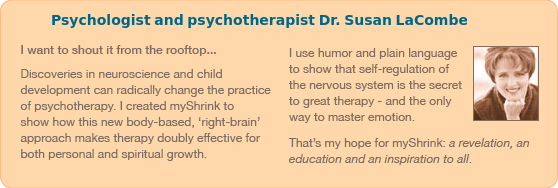
When I'm out in public and mention that I'm a psychotherapist folks always want to know what it is that I do.
This is how the conversation usually goes...
"How does counseling work?
Do you give people advice?"
Well, a bit, but if if I do too much I wouldn't be doing my job. (See Advice Giving)
"So you listen to people?"
Well yes, but that's not really describing it adequately.
"And you ask them questions."
Yes, that's also part of it.
"Well then, how does it work?"
Sometimes clients want to talk about a specific issue, and sometimes I ask questions to identify what's bothering them. In either case--in the moment--they are typically experiencing something negative, which is emotionally triggering.
But this time around, they experience that same topic in a more positive way. It's more positive because by then we've established a relationship, so it's safe to talk about it.
They feel heard. They know that I "get" how they're feeling, because I'm experiencing a little of what is causing their pain. And that's often comforting.
I accomplish this by being attuned to their inner state.
But how does that change things?
Essentially I help them move into, or access, their inner resources.
I'm bringing their awareness to the present moment, having them notice their feelings, their body sensations and their thoughts. I introduce resources that might ease their activation, such as an favorite fantasy, a fond memory, or even our connection as client and therapist.
Think of a negative thing being paired with something positive. It builds up their core a little bit more so they can handle that same subject better in future.
"But can it really change someone?"
Yes, because when you provide a way for the brain to experience something new, change occurs. Add focused awareness to the moment and the new way of experiencing that same thing gets integrated.
And if you change the brain, it changes how you experience your world.
Huh?
So, another way of saying it is...
When I take them out of their patterned way of reacting to things and bring them into resource, it stimulates a rearrangement in the brain's wiring. New neuropathway connections appear, which has the effect of bringing the nervous system into balance.
In other words, the activation associated with their particular issues diminishes.
And the long term benefit is that when this process is repeated over the course of the client's therapy it can restore the inborn ability of the nervous system to regulate itself.
Over time, clients become emotionally more resilient, with an increased capacity to manage stress and living joyfully.
Oh, is that all there is to it?
Yup, that about says it.
If you feel that your feelings are snowballing and preoccupying more and more of your time, then you may want to consider getting help now rather than later.
Finding a therapist (i.e. the right one) and then getting an appointment can be a chore in and of itself, leaving precious time to pass. Thankfully, there are experienced psychologists that are pre-screened and ready to assist you right this moment, so the feelings can be de-escalated (quelled) instead of getting to a point where they are overwhelming...